Hello,
From previous post i explain the theory of the major scale. As a case study i used the scale of G#.
Today, Let us do some practicle on F# major scale by using the diagram below: I want you to get your guitar and lets do it. If you can see on the notes showed on the diagram only on from the 1st fret till the 4th fret. Normally, I advise people to use the 1 finger for 1 fret. This to ensure that we play in a correct movement and utilise the fingers effectively. So lets refer this picture to indicate the fingering on your left hand:
 Use your No 1 finger every times you play the notes on the first fret. No 2 finger for notes on the second frets. No 3 finger for the 3rd fret and No 4 finger for the notes on the 4th fret.
Now you may start playing from the F# notes on the lower E string using your No 2 finger. Use the alternate picking: (UP, down, up, down etc etc etc...) by doing this that means as you play the F# note using down stroke picking then followed by the next note which is G# using the up stroke picking. An next the Bflat note with down stroke picking.
For beginners carry on playing the notes until the next octave of F#(the next red dot on th 4th string). Repeat this process until you familiarise the notes, the fingering and the picking. Once you feel comfortable carry on until you finisih the notes on the 1st String.
Thats it!!! You just play the F# major scale in ascending motion. Also, you should try to play the scale descendingly.
Keep on rocking!! 
Saturday, November 17, 2007
The major scale: technically.

Friday, November 16, 2007
The Major scale: for beginners
Hello again,
As some people ask me online about scale, so today I want to explain about it.
We've looked at a few basics around the guitar, and discussed what notes are, the very foundation of music. The next step is to start understanding scales. The problem is that when some people are presented with scales for the first time, and realize that they are being asked to play endless variations of these scales for the foreseeable future, it can become a daunting task. In this introductory lesson we are going to explore some of the reasons that scales exist, and why we make such a big deal about them.
What are scales? A Technical View
There are 12 possible notes(E, F, F#, G, G#, A, A#, B, C, C#, D and D#) available for constructing music out of. Western music has evolved such that rules have emerged over how and when you use these notes together. Although this is merely convention, you will be so used to hearing the various common scales that when those rules are not applied, or are applied differently you will immediately notice that something is wrong or different. There is nothing written in stone about the way these things are organised, but we are all so used to hearing music from an early age that incorporates these rules that we don't even think about the alternatives until we start to study musical theory in depth.
As a guitar player, you need to understand these rules if you want to play western style music at all. A fundamental part of these rules and conventions are the musical scales we use.
What is a scale? It is a restricted sequence of notes, chosen from the 12 available, that work together to give a certain desired mood or effect to the music. The best way to describe individual scales is as a list of gaps between the notes, we use the term Tone or Semitone to denote our Half notes or Whole notes, and give the formula using their initial letters, T and S.
Some people use Half and Whole (W,H) to denote the gaps, and another way is to list the number of semitones (1 or 2). Either way, these three are identical and all give the gaps for the major scale:
1. T T S T T T S
2. W W H W W W H
3. 2 2 1 2 2 2 1
Lets see how this works. Picking a scale at random - G# major. This initially tells us two things. First, our root note (or first note in the scale) is G#. Secondly, we will be using the Major scale formula to work out the notes.
So, we start with our G# note, and add the first step of the formula which is a T, meaning a Tone. So starting with a G# and moving up a tone or two half notes puts us onto A#:
G# + T = A#
Next, we start with A#, and look at the next letter in the formula - its a Tone again, so we add 2 half notes to A#, to give us a C:
A# + T = C
Next, we start with a C and check the formula - this time it is a semitone, which takes us to C#:
C + S = C#
If we carry on with this we get the following:
C# + T = D#
D# + T = F (remember there is no such thing as an E#)
F + T = G
G + S = G#
So, we have built our scale of G# major according to our major scale formula to get the notes:
G# A# C C# D# F G
The majority of scales we use have 7 notes in them but that is not a hard and fast rule. For instance, the minor pentatonic scale only has 5 notes in it (its formula is 3 2 2 3 2 - I used numbers here instead of T and S because it has a couple of Tone and a half leaps, which is 3 half notes, and that is more easily written down as a 3 instead of something like "T + 1/2", but it all means the same thing). Some scales have more, for instance the chromatic scale has all 12 notes in it.
So that's how scales work! The formula describes them and we pick whichever root note we want to construct them around. The next step is to convert these notes into a pattern so that we can play it.
Have a nice day.
Thursday, November 15, 2007
Picking technic: Single and alternate picking.
Hello,
Here I like to tell you about picking technics. In general there 2 kinds of picking tehcnic, namely single and alternate picking.
Single picking means we pick a string and then play about 2 or more notes per string. In simple way of explaining with a single pick on a string we play no matter how many notes played on that string.
And for alternate picking means we pick the string on every single note we play. Normally we pick in the motion of down and up stroke continously. For example the stroke will be down, up, down, up, down... and so on.
Anyway, I believe most guitarist being taught of using the technic of alternate picking. I suggest that to be a good guitarist we must learn both so we can get more technics and apply it to our playing to make it more versatile.
Thats it! Generally about picking.
See you guys around.
Sunday, November 11, 2007
Pain while playing guitar!! Stop!!!
Hello again,
I like to tell you about my experience a few years back. I woke up in a morning one day, without brushing my teeth or go to the washroom I get my guitar plug the cable swtich on the amp and effect and started playing "Master of Puppet-Metallica".
Just in a few minutes i started to feel the pain on my hand muscle and and palm area. But i just carried on my playing. Until one point its really heart. THen i stop and get ready to work. To tell you the truth the pain still there for the whole day. Thats the bad lesson I learnt. Do some warm up before starts playing your guitar.
The point I want to tell you today is if you feel the pain or sore in your hand while playing guitar just stop it immediately and have your some rest. Pain is your body's way of telling you that you're doing something wrong. Stop and rest is a good solution. If the pain or soreness persists, see an orthopedic specialist to make sure you aren't developing tendinitis.
In my case, i need to go to the clinic and have to put my hand bandage. The doctor advise me to rest and not to play the guitar for days. Thats awful, but even awful i heard that somebody had to stop playing guitar for month because of the same problem...
Hope it is not happens to you.
Thursday, November 8, 2007
Pedal Effects VS Multiple Effect
I was asked by a friend, which one is better, Indvidual pedal effects(FX) or Multiple Effect(MultiFX).
In this kind of issue there are good side and bad side of both. Thats y some people are prefer to use the pedal FX rather than the MultiFX. Let see:
FOR Pedal FX.
The good thing about PEdal FX is we can tweek the knobs there and then to get the feel and the sound we want to. Moreover its easy to understand how it works and flows. Some people said that the sound come out from the Pedal FX are more determine and 'big', u know. It sounds really Original ALIVE and beautiful... Thats y many multiFX try to immitate the pedal FX sound.
The bad thing is if need to use a lot of pedalFX in a line from your guitar to your amps, then the problem starts. 1st, economically it is expensive to buy a bunch of pedal effect. THen you will get power supply problem, I dont think most people like to use battery all the time. Even if we use power adapter and daisy chain the power wont stable is certain situation. Even a lot of PEdal FX in line will create some unwanted buzzing sound. I tell you!!! Its irritating.
For MultiFX.
The good thing about MultiFX we can get as many built in effect as we want and change from to another at no cost. Relatively cheaper then a bunch of Pedal FX. Some multiFX has more than 60 effects. So you can get as many sound as we want to. The features that very significant is we can store the setting into many patches. I believe 30 patches is consider alot. Even extra features like amp simulator, built in tuner, drum machine, metronome or many others give a lot of advantage.
The bad thing: I met a person that just bought his MultiFX after a week he got a headache. He doesnt know to do his own setting. Thats the problem, it takes time to do some setting according the sound that we want. I think a must to read the manual, if not u will be lost. Unlike the pedal FX with out manual u can just tweek-tweek and rotate-rotate the knob and done. To tell you the truth some guitarist takes about a month to make use and completely store their desired sounds.
Ask your self with one suits you.
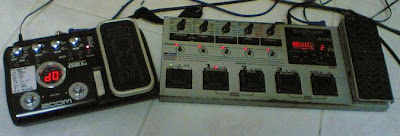
These are my MultiFX
Tuesday, November 6, 2007
Get use to your guitar pick
Hello again,
Talking about the pick for me by choosing the right guitar picks will make not only the comfortablity, though it will give u a good sound and tone.
YOu should have ur favourable guitar picks. THere are a lot of shape and thickness. Also they made from some different material and color. Spend some time to get a different types of picks and do some experiment so will know the different of each and then choose your best one for you. Get use to it, appreciate it and love it. Those pick in the picture is in my collection.
For your information there is no pick can last forever. One day somehow it will torn up and overused. U need to change it, is good to have stocks of picks. DOnt be so stingy by having just one pick. Put ur pick stock in your guitar case so u can get it easily when u need it next time. ALso good if you have pick holder attached to your guitar.
Have fun
Sunday, November 4, 2007
The Major Scale and minor Scale
Hi,
Today I like to explain a little bit about the major Scale relatively to the minor scale.
Dont you guys know that there are 2 scales thats the same? I mean one major scale that similar to one minor scale. It has guys. believe. For instants let me tell you that G major scale is similar to E minor scale. and also D major and B minor. F major and D minor, C major and A minor
But how this things happens?
As a principal there are 7 notes in natural major scale. For easy reference lets use the scale of C. THe notes contain in the scale of C are:
C D E F G A Aand B
and the scale of A minor is: A B C D E F and G. if you can see the 2 scales has the same note, so it is similar. The only different is the starting note C and A both for C scale and A minor scale respectively.
I give you some other scales that similar:
C# and B flat minor scale.
D and B minor scale.
D# and C minor scale
E and C# minor scale.
F and D minor scale.
F# and D# minor scale.
G and E minor scale.
G# and F minor scale.
A and F# minor scale.
B flat and G minor scale.
B and G# minor scale.
So for me it this thing help us to remember either the major or minor chords. Its similar.
Have fun.